|
Hopping back into
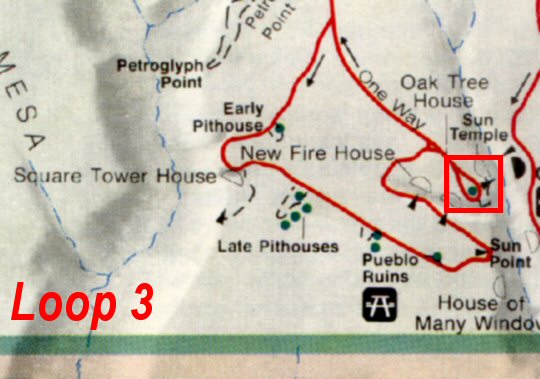
the vehicle, we proceeded around the loop to our final destination.
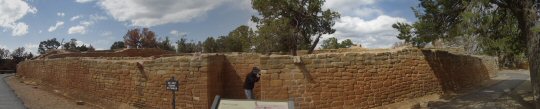
Here we can see Sun Temple. Due to this picture being a panorama, the outer wall appears to be curved. It is actually one straight side (see next image below).
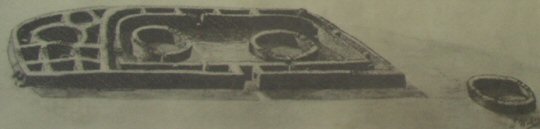
This place holds memories for my brother and I. In years past, they allowed people to climb up and run around on the top of the walls and down in the passages. There was a wooden ladder or two that enabled people to climb up onto the wall. It is probably much more expensive to maintain the ruins today. To make sure these ruins last for many generations into the future, they now prohibit climbing, walking or sitting on the walls. It may also be that during indian tribe counsels, the tribes have requested (along with no more digging) to disallow people on Sun Temple. I have been there two other times (for a total of three times), and my brother, Tim, was there four times. The first time was with our family, many years ago. The second time we went there with a friend. Then Tim went there with another friend (while I stayed home). This was in 1990. On each of these occasions, running around on Sun Temple was allowed. Tim and his wife, Annette, visited Mesa Verde in 2002, and it was prohibited by this time. Seen from above, Sun Temple has a D-shape.
>It's central area has two Kivas. It appears that the structure was not used for habitation. The rooms had no doors, windows or firepits. It is believed that Sun Temple was made for ceremonial uses only. The massive construction of this ruin was probably a community-wide effort. People from the surrounding cliff dwellings may have helped with this project. It appears that the structure was never completed. There is no evidence of a roof or roof timbers. Referring back to the panorama above, you can see Jeff standing in a little alcove, seemingly videotaping a wall. Actually there are windows (or doors) in the walls on the left and right, providing a look-see at part of the passageway surrounding the main part. Here is a view of the passageway to the left
and to the right. 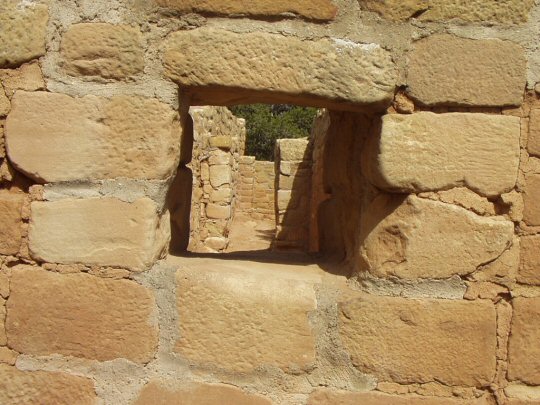
|